

Shanmugam Said “Who Watches the Watchers?” Thinking That No One in Singapore Will Dare to Challenge Him and His Fellow Ministers
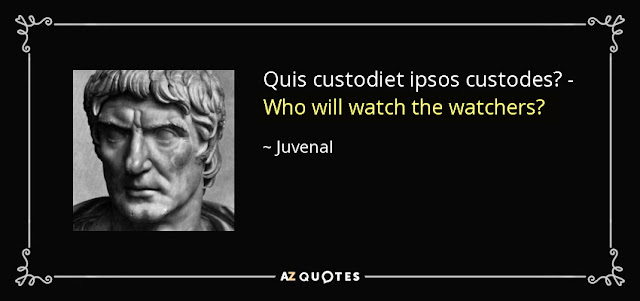
When i published my blog “Shanmugam Uses the Agency He Controls to Defend the Indefensible” I used an image “Who Watches the Watchmen?” drawn from Marvel Comics’ Watchmen series to illustrate how the whole PAP culture of “Ownself Check Ownself” had led us to the situation in which two senior Ministers had helped themselves to enormous properties on huge tracts of state land without disclosing this.The Minister for Law’s breach of the Ministerial Code was particularly egregious because he ultimately headed the Singapore Land Authority (and appointed its CEO) tasked with maximising the returns from Singapore’s supposedly precious land reserves.
A few days ago I was amazed to read the same words, though in the original Latin, used by Shanmugam in Parliament in April 2022 to ridicule WP MP Leon Perera’s proposal in Parliament for an independent ombudsman to investigate Government malfeasance. Not surprisingly Shanmugam was as usual using fake and disingenuous analogies from other countries to bamboozle and gaslight Singaporeans. So nothing new there. However with the knowledge now that Shanmugam had hidden his tenancy at 26 Ridout Road (as Balakrishnan was hiding his at 31 on terms that still haven’t been disclosed and that had been renewed for several more years his words are deeply ironic and farcical.
Here are excerpts from his response (together with my comments):
If there is wrongdoing by anyone, whether a Minister or civil servant or private sector person, there will be investigations. Very few people doubt that. And, over the years, we have added on the checks. This Government has added on checks on itself, which are very rare elsewhere. We institutionalised it such that the CPIB can go straight to the Prime Minister but, where the Prime Minister himself is the possible subject of investigations, or if the Prime Minister does not want to do something, the CPIB can go to the President. Not many countries have done this. As I have said, I will come back to this point.
Therefore, if there is any wrongdoing or suspected wrongdoing, known to anyone, including suspicion of foreign interference or influence, you can let CPIB know. CPIB has the resources to carry out the investigations and it has the ability to tap onto other agencies for the appropriate additional help or work that needs to be done. And FICA put in place a framework where interactions cross the line and you become the subject of foreign influence. So, there is a legal basis to act.
The CPIB is under the control of the Prime Minister’s Office (PMO) and LHL appoints the Director of CPIB. I would humbly suggest that the likelihood of the CPIB investigating the PM for corruption is about the same as the chance that the Singapore Land Authority (SLA) would stand up to Shanmugam when he sought to take advantage of his position as its ultimate head, i.e. nil. On the only occasion when the then PM, Goh Chok Tong, could have referred LKY’s and LHL’s advance purchases of Nassim Jade and other HPL properties at discounts not available to the shareholders (the corporate equivalent of raiding the reserves for the benefit of an elite few who were not even shareholders) he chose not to do so. Neither was the then Director of CPIB brave enough to initiate an investigation.
Mr Leon Perera’s suggestion, if I understood him correctly, is that why not we set up a separate ombudsman with the resources to carry out all these investigations? Because he had a question about whether the CPIB was adequately resourced, trained, does it have the ability to handle these matters? So, my inference from that way of phrasing the question is, therefore the agency, whichever agency is set up, must replicate, I suppose, many parts of our law enforcement agencies, including our intel agencies, so that they can do this on a standalone basis. If that is the suggestion, if I understood him correctly, I would suggest it does not make much sense because how do you replicate, and at what cost an entire investigative mechanism outside the Government?
Shanmugam is right, though not for the reasons he gives. Any attempt to set up an independent mechanism outside the Government is doomed to failure as long as the PAP have absolute control of Parliament and the executive. It will just be wayang, quickly captured like every other institution in Singapore by LHL and his family which will ensure that the appointees are people closely connected to him. We will just have the same situation where the Auditor General is the wife of a PAP Minister. The only way to hold the Government accountable is to elect more Opposition MPs, who will not succumb to pressure and don’t go around praising the PAP, saying they should continue in power for the next 50 years and offering to keep them there should the PAP, heaven forbid, lose their majority like Pritam Singh offered to do a few years back. If Singaporeans really want to find out what is going on then they need to change the Government.
…
If you only have the ombudsman without this apparatus that I have described, then he or she will go to the law enforcement agencies. Here, in such a situation, the law enforcement agencies can go to the President. That is the check. There is an independent person who can give the directions and who can authorise.
As we all know the President is a PAP puppet and will not rock the boat. Anyone who might show a shred of independence or desire to investigate will be excluded under the carefully drawn criteria. If all else fails the Presidential Election Committee can just exclude anyone LHL doesn’t like on grounds of moral integrity or some such subjective criteria. JBJ was excluded despite his fake conviction having lapsed after 5 years and despite the Privy Council calling for a free pardon. The Government has made it clear that the PM’s own brother will be excluded under these criteria despite never having been convicted in a court of law.
…
Third, let me ask, you set up an ombudsman with or without the full suite of resources and without any oversight from the Government, who then deals with misconduct by the ombudsman or the officers within that office?
Mr Leon Perera said during the FICA debate “quis custodiet ipsos custodes?”, if I recall correctly. For some reason, I think that phrase seems to have lost favour now. Who guards the guards? Take a hypothetical situation: say, you have an organisation, where the top leaders engage in wrongdoing or, for example, say, they set up a disciplinary committee to cover up what they did rather than actually investigate, I think you can ask “quis custodiet ipsos custodes?”. And if Mr Leon Perera – I suppose if he was part of any such organisation, would be the first one to make such a point.
It’s deeply ironic that Shanmugam used this phrase because this was precisely the question I asked of Shanmugam as Law Minister and head of the agency he was entering into a lease with. Who in Singapore watches the watchmen?
But for the Government, with the systems in place and the variety of people who can lodge complaints and investigate – AGO, Attorney-General, you have CPIB, the Police – civil servants are obliged if they think that a Minister is doing wrong to take it up to a higher authority and, if they believe that the higher authority is not acting properly, they can take it up all the way. And these civil servants are protected through the structure of Public Service Commission, which, in turn, is protected through the fact that appointment cannot be interfered with willy-nilly by the Government. So, if you take the senior appointments, including the chief of CPIB, Chief Justice, Attorney-General – all these – there are carefully constructed structures on these appointments. So, I would say, look at all that first and look at the ground situation before we start talking about replicating more and more institutions outside.
Shanmugam is again being deeply disingenuous given the fact that all these institutions come under the control of the PMO. The Auditor General is the wife of a PAP Minister, the AG is LHL’s former personal attorney who has been appointed for an unprecedented three terms, the DIrector of CPIB reports to LHL. the Civil Service has been thoroughly captured and is. just a training ground for future PAP Ministers due to the PAP’s long time in power.
In contrast, look at countries with a longer runway of democracy. Australia – I stand corrected – but in the short time I had since Mr Leon Perera spoke, the example I found is Independent Commission Against Corruption (ICAC), a state-level agency that reports to the premier; in this case, the case that was highlighted to me, the Prime Minister of New South Wales.
If you look at what is the situation in the UK – I am reading from something that says “Institute for Government – Ministerial Code”, what does the Code say? All of the Codes, meaning the Codes for Wales, Scotland and UK, give the final authority for decisions about action to be taken to the Prime Minister or First Minister or, in Northern Ireland, the relevant nominating officer for a particular Minister’s party. So, it is the prime minister. Since 2006, UK Government Ministerial Code breaches have been investigated through an independent adviser on ministerial interest or by the cabinet secretary, but there is no requirement to follow any particular process. That is the UK situation. And I think the Member will be well aware of the situation in the UK more recently and for some period in the recent past.
The difference between Singapore on the one hand and Australia and the UK on the other is that in the latter two countries there is a strong Opposition willing and able to hold the Government accountable for breaches once they are discovered. A Government like the PAP’s that ignored flagrant and intentional Ministerial Code breaches and corruption would soon find itself in Opposition. As we have seen in the UK with Boris Johnson, even sitting PMs can be held to account and prosecuted. Contrast this with Singapore where LHL and his dad were able to sail through the Nassim Jade corruption scandal without censure, where the PM can have his wife appointed as head of Temasek on a salary he refuses to disclose and where two Ministers help themselves to two of the biggest residential properties in Singapore despite the Minister for Law heading the agency which rented him the property and that refuses to disclose the rent or any of the other circumstances I have highlighted. I called for a Commission of Inquiry headed by an independent, preferably foreign, judge. Instead Singaporeans have been fobbed off with a review led by a Senior Minister who was likely aware already of the unusual arrangement.
Perera’s call for an ombudsman is indeed a waste of time. It’s the duty of the Opposition in Parliament to watch the watchmen. Without an Opposition able and willing to do so, the PAP will continue to display their contempt for Singaporeans by claiming that “Ownself check ownself” is all we need. The Ridout saga demonstrates yet again why we need to change the Government so that the light of day can be shone into all those corners where LHL, his Ministers and friends and cronies have so successfully evaded scrutiny.


answer back
 | Immigration and Nati… on An Imaginary Climate of F… |
 | Good Person on Correction Notice: This Post C… |
| security of S’… on Correction Notice: This Post C… | |
 | Dear Lawrence Wong,… on Should Singaporeans Be Loving… |
 | derekgoh05 on Is MAS’s Promise to Inve… |
 | Kurusamy on It’s Heartbreaking That… |
 | Chin Tulan on As the Supply of BTO Flats Ram… |
 | abao on As the Supply of BTO Flats Ram… |
 | Robert Shulman on Shanmugam: A Whiter Shade of… |
| Ramli Kay on While State Media Report on Ho… |

 The Ricebowl Singapore (TRS)
It’s not for nothing that in some Internet forums Shanmugam is known as the SHAM. Presumably, for his habitual cock-talking.
LikeLike
Yes its true, if nobody checks they are scotfree as Singapore is theirs own,
LikeLike