

Singaporeans Have Allowed the PAP Elite to Hijack Policy Making to Make Themselves Obscenely Rich

Today Henley and Partners, a firm which proclaims itself as the global leader in advising the ultra-rich (usually defined as individuals with at least US$30 million in investable assets, which class includes most of the senior and former PAP Cabinet Ministers including of course Law Minister Shanmugam and ex-PM LHL) released its 2024 Centi-Millionaire Report.
This started off by saying that there are currently 29,350 super-rich individuals with investable assets of US$100 million or more. Americans continue to dominate with New York, San Francisco and the Bay Area, and Los Angeles occupying the top 3 positions on the list of cities by numbers of centimillionaires with. London in fourth position and Beijing fifth.
Singapore ia in sixth position with 336 centimillionaires, only 11 behind Beijing which is a much bigger city and at the centre of the world’s second biggest economy. According to Henley, the number of centimillionaires is expected to grow by more than 100% by 2040, far outpacing growth in the US and Europe.
This isn’t happening by accident. THe whole thrust off PAP policy has been to encourage the ultra rich to take up residence in Singapore. There is no capital gains tax, no tax on income from abroad or on investment and interest income. The top rate of tax on earned income is 23%, half that of the UK or the US and only payable at much higher levels of income. It is in any case doubtful that any of the ultra rich take their remuneration in the form of earned income when taxes on other sources are zero.
Back in 2013, PM Lee Hsien Loong said:
“In fact, if I can get another 10 billionaires to move to Singapore and set up their base here, my Gini coefficient will get worse but I think Singaporeans will be better off, because they will bring in business, bring in opportunities, open new doors and create new jobs, and I think that is the attitude with which we must approach this problem.”
Singapore has also made it very easy for the ultra rich to acquire PR status and be fast tracked to citizenship. Nor, whatever the anti-money laundering laws say, has it been at pains to inquire too deeply into the sources of wealth. As seen by the recent huge money laundering scandals, which were preceded by 1MDB, there’s no shortage of people in local and foreign financial institutions who are seemingly prepared to bend the rules or not carry out the necessary anti-money laundering checks. However even a stricter money laundering regimen is unlikely to have made more than a marginal difference to what has happened.
Maybe the influx of billionaires and UHNWI has resulted in some jobs created for locals but many more will be done by foreigners. They pay no direct taxes and while they might pay a lot in terms of GST and car tazes on local consumption this is unlikely to be more than a small fraction of their global income which goes untaxed. They will buy foreign luxury goods and if they eat out it at Michelin starred restaurants a lot of the income will go to the foreign celebrity chefs.
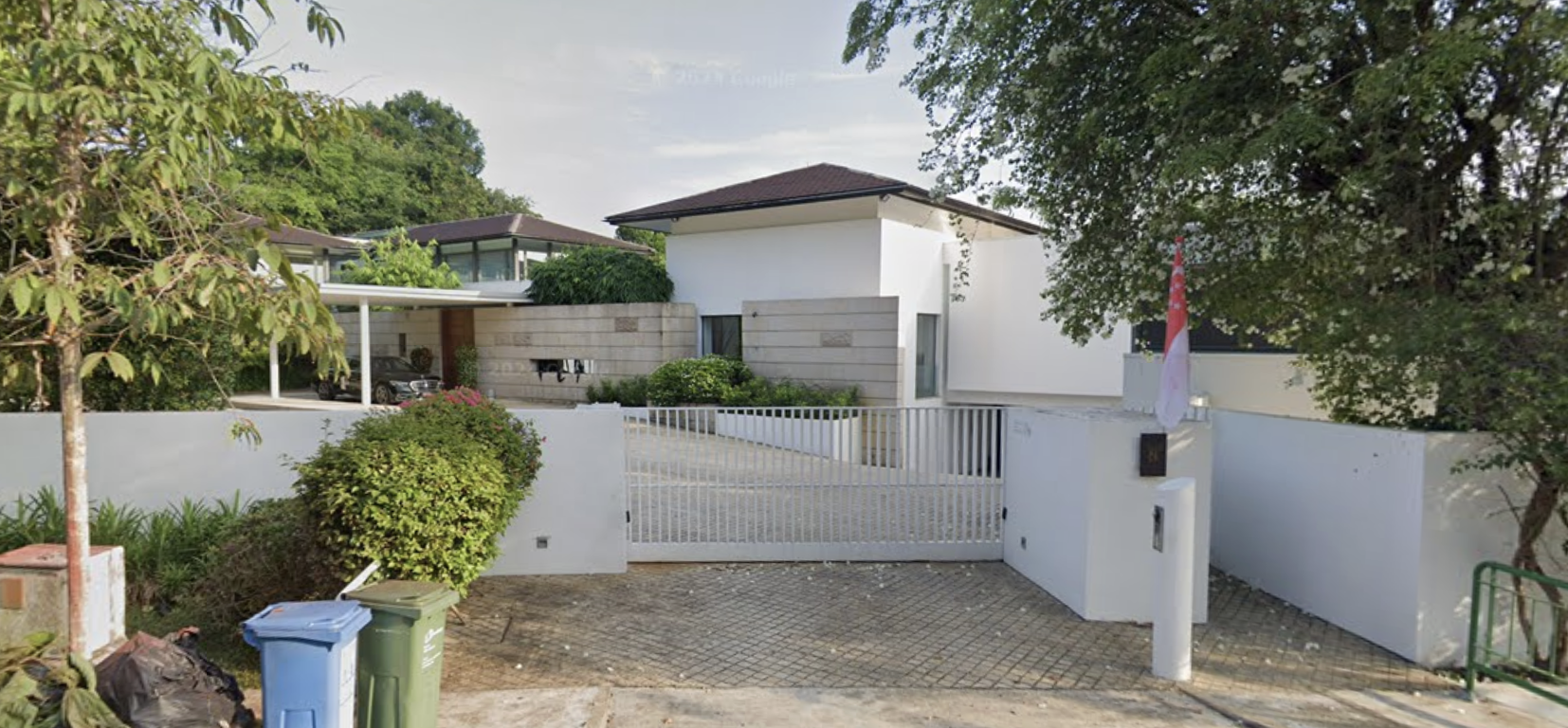
What they have done is bid up tremendously the prices of goods in inelastic supply like Good Class Bungalows, which have risen at exponential rates. I recently drew attention to the stratospheric increase in the value of Shanmugam’s GCB at Astrid Hill which he bought for $8 million in 2003 and by the time he sold it in 2023 its value had risen to $88 million. This is an 11 -fold increase in 20 years and works out to a 13% compounded annual rate. This is much better than the S&P 500 managed over the same period (10% p.a.) and better than most fund managers. It is particularly extraordinary for a safe asset with little risk compared to stocks.
Most of the senior and former Cabinet Ministers own landed properties. Shanmugam has undoubtedly joined the ranks of the world’s centimillionaires with this sale but LHL and his wife must have a property portfolio worth many hundreds of millions, much of it inherited. When adopting the policy it would be naive to think that they didn’t realise the consequences and how much it was likely to enrich them. But they sold the policy to Singaporeans as benefiting them while in fact it has had the reverse effect. It has pushed up property prices and more or less locked ordinary Singaporeans out of ever being able to own a landed property in their own country. Meanwhile, as PAP Ministers laugh all the way to the bank with their tens or hundreds of millions of dollars, Singaporeans are told that HDB must be kept leasehold and restricted to 99 years tenure on the basis that to allow them to own their own property would be unfair to future generations.
In the 1960s a British economist, Fred Hirsch, wrote about limits to growth because of what he called “positional’ goods, like uncrowded beaches, that were scarce. GCBs would fall into this category. As people got richer and fulfilled their other material aspirations they would bid up the prices of these assets to the point where they realised that despite working harder and harder they would never own them. The PAP have done something similar in Singapore. They have sold you on policies that they say will benefit you but the lion’s share of the gains have gone to them. Then they try and hide the facts from you. Have PAP Ministers, MPs, spouses and the rich benefited from LHL’s policy of attracting the world’s billionaires to Singapore? Undoubtedly. Ordinary Singaporeans, not so much.


 The Ricebowl Singapore (TRS)
answer back